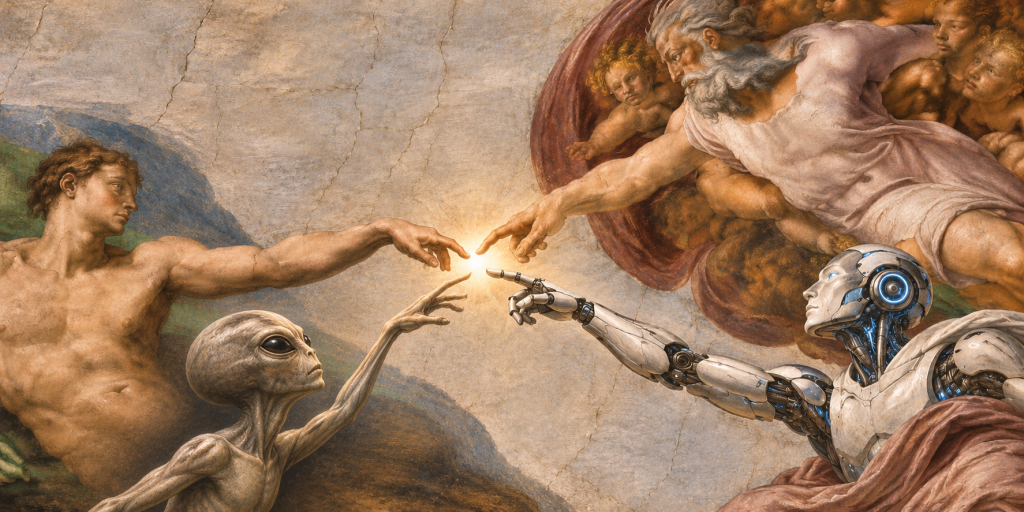
No. End of blog.
Sure, I could have done what folks who write and post online recipes do. You search for a recipe for “lemon cheesecake” only to have to scroll through five screens of how the author spent their summers as a kid picking fresh lemons off of dew-soaked trees in Nonnie’s orchard. I’m just trying to figure out how much cream cheese I can use on my morning bagel and still have enough to make a cheesecake later!?
I could have started this blog by telling you about the history of this question from a scientific perspective. Well, it is the first rain of the season and I’m stuck inside, so I guess I will…
Way back in the sixties, a time of experimentation in many arenas of life (so I’m told), scientists began listening to the heavens, hoping to answer one of humanity’s most intriguing questions: Are we alone?
The possibility that intelligent life exists somewhere beyond our planet inspired scientists, science-fiction writers, philosophers, and even some of the wealthiest people in the world to put their time and effort into discovering the answer. Perhaps there is another civilization out there wondering the same thing about us? Perhaps someone is trying to communicate with us? And after years of not getting an answer, perhaps we simply haven’t figured out how to listen properly?
The Search for Extraterrestrial Intelligence, known by its acronym SETI, was the scientific effort attempting to answer that question. I discovered (hey, does that make ME a scientist too?) its history has some interesting connections to our own Silicon Valley backyard.
The SETI effort began in 1960 when astronomer Frank Drake conducted an experiment called Project Ozma. Using an 85-foot radio telescope in Green Bank, West Virginia, Drake directed his attention toward two nearby stars, Tau Ceti and Epsilon Eridani, nearly 11 light-years away. His theory was straightforward. If an intelligent civilization existed around either star, perhaps it was transmitting radio signals (just like us) that we might be able to detect. He concentrated on a particular radio frequency associated with hydrogen, the most abundant element in the universe, reasoning that an advanced civilization might recognize its significance.
The experiment cost only around $2,000. While no extraterrestrial signals were discovered, the effort kicked off a full-fledged scientific pursuit. NASA became involved, investing over $57 million in SETI-related research before Congress terminated its funding in 1993. Private supporters then stepped in to keep the search alive. And this is where the story hits a little closer to home. Among the people who helped sustain SETI were some familiar names from the history of Silicon Valley. Bill Hewlett and David Packard, founders of Hewlett-Packard, Gordon Moore, co-founder of Intel, and Paul Allen, co-founder of Microsoft, each committed $1 million annually for five years to support the search after NASA funding was withdrawn. That’s $20 million from just four individuals who helped build the technology industry that transformed our world.
Some of the wealthiest and most technologically accomplished people of the time were willing to invest millions of dollars in the possibility that intelligent life exists somewhere beyond Earth. Yet, despite decades of research, billions of observations, and increasingly sophisticated technology, we have not received a confirmed signal from another civilization.
Some of today’s wealthiest tech entrepreneurs are investing enormous sums in artificial intelligence, and the ambitions occasionally sound almost theological. Elon Musk, Sam Altman, and others in the technology industry have spoken about developing AI that goes further than answering everyday questions, suggesting that sufficiently advanced intelligence might help solve humanity’s greatest problems, discover truths beyond our current understanding, and fundamentally change what it means to be human. Given enough time and money, we can develop an intelligence that will know more than we do, anticipate our needs, guide our future, and even become an eternal companion!
Okay guys, take a breath. Artificial intelligence may become extraordinarily capable, but intelligence and divinity are not the same thing. Knowing virtually everything about the physical world would not provide wisdom, love, purpose, or a relationship like we can enjoy with our Creator.
So, are we alone? The Biblical answer is no, and that we have never been alone. There is an important distinction between feeling alone and actually being alone. Christianity doesn’t promise that we will never experience loneliness. Even Jesus experienced abandonment and anguish. What Scripture does offer is the assurance that God’s presence doesn’t depend on our ability to feel it.
The Bible offers powerful assurances that we are never beyond God’s presence. Here are my favorite three:
In Isaiah 41:10, God tells His people: “Fear not, for I am with you; be not dismayed, for I am your God; I will strengthen you, I will help you, I will uphold you with my righteous right hand.” The reason God gives for overcoming fear isn’t that difficult circumstances will disappear or that life will suddenly become easier. It is simply that He is with us. There is considerable comfort in knowing that we don’t have to navigate life’s disappointments, uncertainties, and challenges entirely on our own.
Psalm 139:7 takes this assurance even further. King David asks, “Where shall I go from your Spirit? Or where shall I flee from your presence?” He considers traveling to the heavens, descending into the depths, or journeying to the farthest reaches of the sea. His conclusion is that there is nowhere he can go beyond God’s presence.
Finally, in Matthew 28:20, the very end of Matthew’s Gospel, Jesus offers one of the most reassuring promises in Scripture: “And behold, I am with you always, to the end of the age.” Matthew is preparing His disciples to go into the world, knowing they will face considerable challenges. He doesn’t promise them an easy journey. He promises them His continuing presence.
The word “always” is important. Not just when we are in church, or when life is going well, or when we remember to pray. Always.
Philip Yancey tackles the subject of prayer in his book Prayer: Does It Make Any Difference? He doesn’t pretend that prayer is easy or that every prayer produces an obvious answer. He asks questions that most Christians have probably considered at one time or another. Does God really listen? Why do some prayers seem to go unanswered? If God already knows what we need, why bother asking?
Yancey makes an important observation: We frequently approach prayer as though it were a transaction. We present God with a list of requests and then evaluate the usefulness of prayer based on whether we receive the answer(s) we want. But prayer is intended to be something more. It is about relationship.
Think about our relationships with friends and family. We don’t spend time with them exclusively because we need something. We enjoy their company. We share experiences, express concerns, celebrate successes, and sometimes simply enjoy being together. Yancey encourages us to think about prayer in much the same way.
And perhaps most importantly, prayer can move us beyond our own loneliness. When we become more conscious of God’s presence, we may also become more attentive to the people around us who need companionship. The person sitting alone at church, the neighbor who recently lost a spouse, or the friend who hasn’t heard from anyone in weeks. Experiencing God’s companionship should make us better companions to others.
There is nothing wrong with the search for evidence of life beyond Earth. It is a legitimate scientific pursuit, and I suspect most of us would find confirmation of extraterrestrial intelligence “fascinating” as Mr. Spock would say. Nor is there anything inherently wrong with developing artificial intelligence. This technology may produce extraordinary advances in medicine, science, education, and countless other fields.
But I think our fascination with these endeavors reveals something about our shared human nature. We want to know that we aren’t alone. We want someone to communicate with us, understand us, guide us, and give meaning to our existence.
We have spent decades listening to the stars and billions of dollars developing increasingly sophisticated technology. Some of the wealthiest people in the world are now investing fortunes in the possibility of creating intelligence that surpasses our own.
Yet the Christian faith offers answers from a different starting point. Rather than trying to discover or manufacture an intelligence greater than ourselves, it invites us into a relationship with the intelligence, wisdom, and love that literally created us.
We don’t need to wait for a signal from another galaxy. We don’t need to build a data center encased machine capable of answering every question or chatting with us like a friend. And we don’t need to be particularly eloquent or religious to begin a conversation with God. We simply need to take time to pray.
While we search the heavens for evidence that we are not alone, and manufacture technology to make us feel like we’re not alone, God has already given us His answer. We are not alone.
“I am with you always, to the end of the age.”
Now, back to SFLC, the Search for Lemon Cheesecake…