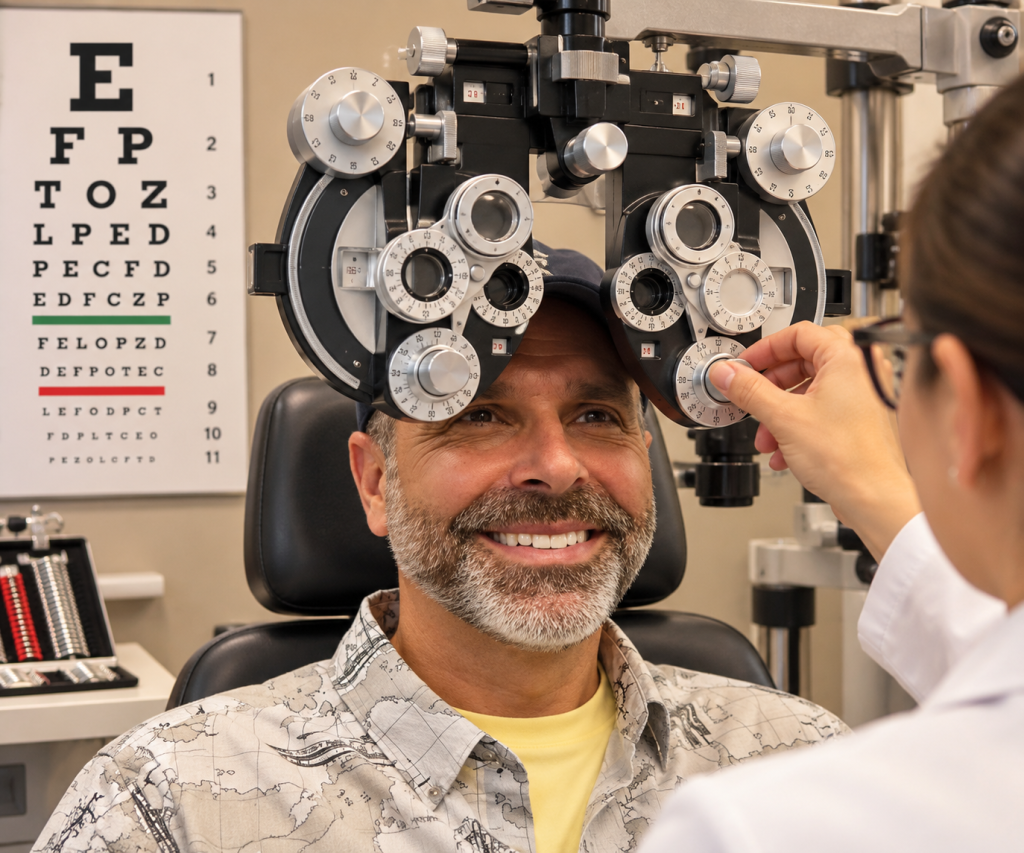
I got my eyes checked today, well, technically they’re still brown. (Dad joke!)
After having computers and lasers map my eyes with astonishing precision, I was eventually seated in a different chair and asked the question that has probably been asked of every patient since the invention of eyeglasses: “Is it better this way… or this way?”
Apparently, despite all those millions of dollars of technology, the final word in determining my exact prescription still came down to me choosing between two equally blurry images.
It struck me that technology is constantly changing, but our language. like the necessity of this eye test, is remarkably stubborn. We keep the words long after we’ve discarded the machines, objects and practices that gave them meaning.
Take dashboard. Today, a dashboard is the panel in your car containing your speedometer, fuel gauge, warning lights and increasingly, what amounts to a small entertainment system. But the original dashboard had nothing to do with automobiles. Before cars, people rode in horse-drawn carriages. The dashboard was the wooden board positioned in front of the driver to protect him from the mud, dirt and debris that horses would literally dash up as they moved down the road. The horses disappeared. The dashboard stayed (I even have one on my computer now!)
We do this constantly. We dial a phone number even though most of us have never actually turned the dial on a telephone. We hang up without hanging anything up (I still picture the black rotary-dial phone mounted on my kitchen wall in 1965). We rewind a movie or video even though there is no tape to wind backward. We record television, although nothing is being scratched onto a disc or magnetized onto tape. We cut and paste without involving actual scissors or tasty, tasty paste (mmm, kindergarten paste). We bookmark a website without putting a piece of paper between two pages. We put a file in a folder without folding anything. We log in and log out of our favorite sites and apps, remnants of the days when computer operators kept literal logs of those who entered and left a system.
And then there is the bug.
The word “bug” as a description of a mechanical or computer problem actually has a wonderfully literal history. In the early days of machinery, an actual insect could get trapped inside a machine and interfere with its operation. One famous example involved a moth found inside a relay of the Harvard Mark II computer in 1947. The operators taped the moth into their logbook and recorded that they were “debugging” the system. Today, when my computer crashes because I clicked the wrong thingy, I am metaphorically still battling bugs, or their even smaller digital cousins, viruses.
The funny thing is that the next generation will inherit all these words without necessarily knowing what they originally meant. They will continue to dial, hang up, rewind, bookmark, cut and paste, and open a folder without ever encountering the objects that gave those words meaning.
And technology isn’t the only place where this happens. Our everyday language is full of theological fossils, words and expressions that have survived long after their original context has faded. We take something as “gospel” when we mean we regard it as unquestionably true. We “idolize” a celebrity without building an altar to Baal. We talk about the “seeing the handwriting on the wall” when we see trouble coming, we invoke the reference “Good Samaritan” when someone stops to help a stranger, and call someone a “scapegoat” when they get blamed for everybody else’s mistakes, all without thinking about where those expressions came from.
Perhaps that is the real danger of forgetting where our words come from: when we lose the story behind a word, we lose some of our appreciation for the thing the word once meant. Technology leaves us with dashboards, dials and bugs; the Bible leaves us with a vocabulary of faith that has seeped into everyday speech. Reading the Bible doesn’t merely explain where some of our expressions came from; it lets us encounter the stories, ideas and truths that gave those expressions their meaning in the first place. So perhaps we ought to read the old book, for no other reason than to understand some of the words we use every day.
Not a bad thought to carry into the future. Language, as it turns out, is remarkably resistant to technological progress. We may replace horses with automobiles, typewriters with keyboards, film with pixels and telephones with computers in our pockets. But apparently, we’re going to keep saying “Hang up” (no, you hang up) forever.
And after today’s eye exam, I’m pretty sure we’ll also keep asking: “Is it better this way… or this way?” And with that, I will say goodbye, a word so ordinary that few of us stop to consider that it is a contraction from what began as the well intentioned blessing / salutation “God be with ye.” Believe me, realizing that you’re actually wishing someone that God go with them when you say goodbye, their day and your day will be “better that way”.
What a nice, scholarly dissertation…
Very nice, Frank
Gave me a lot to think about, and I particularly like your last paragraph… Their day and your day will be better that way! Agree
I enjoyed this blog……thank you for writing it and putting a smile on my face.
As always, an enjoyable read. Simply put, “Good Bye”