I’ve been a fan of The Late Show for years. Stephen Colbert shared funny and insightful observations four nights a week for eleven years. During his final show, he shared his own answers to the often presented “Colbert Questionnaire”. In addition to frivolous questions like “what is your favorite sandwich”, and “apples or oranges”, the list of questions included an especially profound one; “What do you think happens when we die?”
During the last show, I eagerly anticipated Stephen’s answer to this question. He often referenced his Catholic upbringing and even boasted of meeting the Pope. Listening to his answer, I have to say I was sorely disappointed! Here, with thousands to millions of people viewing the last show, he was afforded the opportunity to testify to a great Biblical truth which believers know (or should know) about the hereafter. Knowing our destination is essential to directing our daily decisions and should profoundly shape the way we live.
After some jokes about Purgatory and asking “what are we supposed to say?”, his answer (look at minute 17:30) was “I think there is some continuance, of some kind, but it’s a um like a dispersion of the self, into some other greater being. And I don’t know, I don’t have any other feeling beyond that.“ Jim Gaffigan, who asked the question (and is both a fellow comedian and one who met the Pope), retorted “so what you’re saying is we become Febreze?”
A fitting quip to a wholly unfulfilling answer.
With all on his mind, (not only is he losing his job but so are 200 other people losing their jobs ‘purely for financial reasons’ due to the shows ignoble cancellation), I can show him some grace. But to you fair reader, I offer the following Biblical clarity so you might be both more aware and better prepared to articulate truth.
Eventually everyone asks the same unavoidable question: What actually happens when we die? Many struggle to speak plainly about death. We prefer softer language like “he passed away” or she “departed.” We invent phrases that create a safer emotional distance from the reality and pain of death.
Scripture does not approach death that way. The Bible consistently treats death as something tragic and unnatural, an intrusion into creation rather than a welcome companion within it. Yet at the same time, the biblical writers insist that death is not the cessation of existence. The body dies, but the person created by God does not simply vanish.
That truth appears repeatedly throughout the New Testament. When Paul describes death for the believer, he speaks of being “away from the body and at home with the Lord” (2 Corinthians 5:8). The concise wording matters. Paul does not describe death as unconsciousness or extinction, but as relocation. To leave the body is to arrive consciously into the presence of Christ.
Jesus Himself expressed the same reality while hanging on the cross beside the repentant criminal who pleaded, “Remember me when you come into your kingdom.” Christ answered with a remarkable promise of immediacy: “Today you will be with me in paradise.” (Luke 23:42-43) Whatever mysteries remain about the afterlife, Jesus clearly did not describe death as nonexistence followed by eventual awakening centuries later. That sin-filled man showed his faith through the gift of grace and would be with Christ that very day.
While writing from prison under the shadow of possible execution, Paul echoes the same expectation in his letter to the Philippians. He admits being torn between remaining alive for the benefit of the church or departing this life altogether. Yet when he speaks about death, his language is surprisingly direct. He says his desire is “to depart and be with Christ, for that is far better” (Philippians 1:23). The statement only makes sense if Paul expected conscious fellowship with Christ immediately after death.
Yet the New Testament also insists that this reunion, glorious as it is, remains incomplete. This is where many modern assumptions about heaven begin to diverge from the biblical story line. Popular imagination often pictures eternity as an endless spiritual existence detached from a physical reality, as though salvation ultimately means escaping embodiment forever. Scripture points instead toward a bodily resurrection. The Christian hope is not merely that the soul survives death, but that the whole person is ultimately restored into a new and glory-reflecting body.
This explains why the resurrection of Jesus occupies such a central place within Christianity. If salvation meant only spiritual continuation after death, then the bodily resurrection of Christ would be unnecessary. But the gospel writers go out of their way to emphasize the empty tomb, eating fish, touching wounds. Jesus was not merely spiritually alive in the memories of His followers, He rose bodily. Christianity therefore proclaims not only life after death, but resurrection of the body after death.
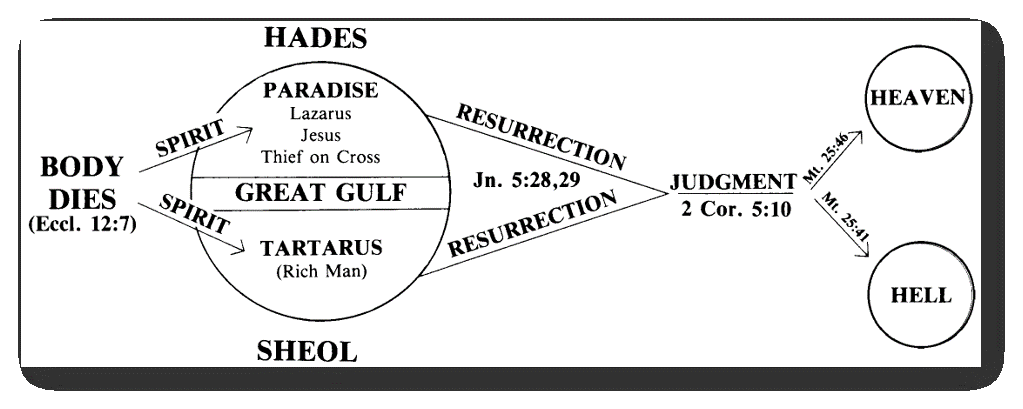
The sequence can be confusing so seeking scriptural clarity is important. According to the New Testament, believers who die enter consciously into Christ’s presence, yet they still await the future resurrection of the body. Paul writes that “the dead in Christ will rise first” (1 Thessalonians 4:16) when Christ returns. Jesus likewise declared that a day is coming when “all who are in the tombs will hear his voice and come out.”
This intermediate state exists, and by definition is not the final state. The biblical story does not conclude with disembodied souls existing forever somewhere beyond the clouds. It concludes with resurrection, judgment, restoration, and the renewal of creation itself.
The Bible clarifies what some assume to be a destination involving reincarnation. Hebrews states with unquestionable clarity that “it is appointed for man to die once, and after that comes judgment.” (Hebrews 9:27) Jesus spoke not only of the resurrection of the righteous, but also of those who face condemnation.
Still, the dominant note for the Christian is hope rather than dread. The earliest believers buried their dead with grief, yet not with despair. They believed Christ had fundamentally altered the meaning of death itself. The grave remained real, but no longer ultimate. Because Christ rose, we believe death has become a temporary condition.
In the end, the proper Christian answer to the question “What happens when we die?” is both sobering and hopeful at the same time. We die physically, then continue to exist consciously before God. Believers enter the presence of Christ (paradise) while awaiting bodily resurrection. Non-believers enter a place of the dead (Hades/Sheol). At the end of days, all the dead are raised (both saved and lost), then judgment comes, creation is renewed, and death itself is finally and forever defeated.
This question will surface in your life again and again. It usually arrives quietly, perhaps during a funeral service while staring at a polished casket or in a hospital room after the machinery has gone silent and the family members have stepped into the hallway to gather themselves. You can be a blessing to share the true, complete, and Biblical insight on death as a means of comforting those now facing a void when it can be difficult to imagine the world continuing without their “dearly departed”. I find a summary testimony of my faith can be made with this statement on behalf of the departed, “They are alive, they are just not here.”
I too was eagerly anticipating Stephen Colbert’s answer ( I love the Colbert Questionnaire and have often used it as ice breakers in meetings =D) I was surprised and disappointed as well with his answer.Thank you for your beautiful description based in scripture of what happens after we die! You made it so clear!
Frank, You have broken this down and explained it so well.
I’ve known all the scriptures, but in jumbled ways. Therefore, making it hard for me to explain to others “my hope” when the Lord calls me home and I die.
Your explanation organized the Bible scriptures in a methodical way for me to clearly understand the sequence of what happens after we die!
Thank you!
Frank, beautifully said! As i get closer to death, i find myself thinking more and more about life after death. I continue to seek God’s assurance, through scripture that we will share “paradise” with our risen Lord!
You always provide meaningful explanations. Thanks!
Frank, well written, and I was also a little disappointed with Colbert’s answer. I ponder why Jesus’s resurrection signifies our heavenly bodies need to be humanoid? Isn’t it to save us from eternal damnation and give us a pathway to be with God and his angels in heaven?, and giving us a chance to rinse away original sin and dynamic sin so we can enter heaven? What is the purpose of our bodies if we don’t need organ function as needed on Earth? Eating, sleeping, blood flow, nails and hair growth…etc….
You ask intriguing questions!
I keep in mind the Garden was the pinnacle of design and we are made in God’s Image. I too struggle with biological optimizations like molars and incisors when no death in heaven (nor the garden initially) required breaking down meat. I figure our body’s design is a choice God made and that will prevail in the upgrade as we better reflect his glory forever. A smile, a hug, holding hands, these are all aspects of my first body that I will cherish even more in my perfected version.
Your explanations are always helpful and on this subject most comforting.
Hi Frank, great explanation, I learned a lot from your summary. This is one of the best, maybe the best of your blog. Please keep it up, I need it. Thanks!