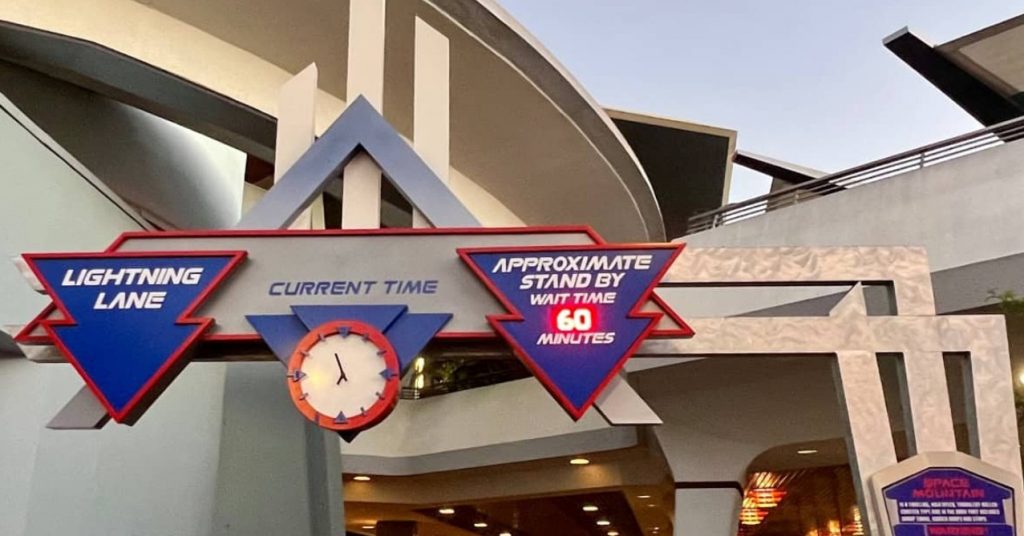
I arrived at Disneyland with predictable expectations. I expected a clean park, relentlessly cheerful cast members, bright lights, and the reliable availability of sugar in multiple forms (my favorite is the “Tigger Tail”; three giant marshmallows on a stick, dipped in caramel, dunked in orange chocolate and drizzled with dark chocolate stripes). I expected the manufactured wonder and the competent logistics of a world-class operation. What I did not expect was how strongly the experience would unsettle me, not because of crowds or wait, but because of how visibly the day was organized around unequal access.
I had assumed, perhaps naively, that the lines would be long but at least they would be shared. I recalled from prior visits (2019 was the last time) there was an esprit de corps from the “we’re all in this together” experience. We assume a quiet egalitarianism when everyone endures the same hour-long wait for the same four-minute ride. Instead, I found a buy-your-way-out-of-the-line (Lightning Lane) system divided the crowd into two experiences of time.
Standing there, watching one line move quickly while the other stalled, I felt the souring of what I had expected to be a common experience. I imagined a room of MBA’s brainstorming ways to increase park revenue. “We can’t fit more people, but we can fit more wealthy people!” They followed the golden rule, misunderstood to be “he who has the gold, makes the rules”. In addition to offering a $35 per person, per day feature to schedule yourself to popular rides (which used to be called FastPass and was free – for a full explanation, see this article), I learned Disneyland offers a “Premier” Pass where you can pay upwards of $400 PER PERSON PER DAY to skip to the front of the line of 24 or so rides!?
In retrospect, I should have been prepared. I have watched this Plutocratic (no, not referring to our beloved Pluto!) use of the misguided “golden rule” unfold elsewhere. Southwest once operated on a simple “pick any seat” model, where boarding order mattered but the plane itself was a shared space offering equal access to seats (and equal snacks!) That eroded into paying for earlier boarding so one could improve their chances to secure a preferred seat. Now the model has shifted again toward explicitly buying a better seat outright, along with small perks that quietly signal tiered belonging. You no longer just board earlier, even your snacks remind those around you where you stand (honey roasted nuts vs pretzel nubs). What surprised me at Disneyland was not the existence of the system, but how normal it has become to experience unequal access in spaces that once felt shared.
The day supplied plenty of small parables.
- Visitors consult the ubiquitous app, see an unusually short wait time posted, power-walk across the park, only to arrive and discover that half of Anaheim had the same app-triggered behavior at the same moment.
- Standing in line, you celebrate progress through the first ten switchbacks only to turn the corner and be greeted by another hundred people and a sign explaining that you are still “only 35 minutes away.”
- Between rides, you pay inflated theme-park prices for snacks, discovering that hype and hunger have a powerful effect on your theology of stewardship.
- The lines move along just enough to maintain hope, but slowly enough to provoke (in me at least) quiet reflection on how easily practicing patience morphs into subduing irritation anytime immediate satisfaction is delayed.
This experience is merely a reflection of a broader cultural pattern. Economists describe the present moment as increasingly “K-shaped,” with some households accelerating upward while others stall or fall further behind. I fully understand being in Disneyland for three days with my grands to be a phenomenal privilege on its own, but it did help me recognize a pattern that is showing up more and more in ordinary life. Priority lanes, premium queues, expedited services, paywalled access, concierge tiers, and algorithmic advantages are now common features of public and private spaces. These arrangements are not inherently unjust. They are, however, formative. They train our brains to experience shared life as something to be optimized out of rather than endured together. Over time, common spaces thin into adjacent lanes of unequal access.
Scripture names this tension with clarity. “God does not show favoritism” (Romans 2:11), and his people are repeatedly warned against favoritism toward those with status or wealth. James confronts congregations that give the wealthy the places of honor while shaming the poor, calling such behavior sinful partiality that contradicts faith in Christ (James 2:1–9). The biblical vision of community resists quiet signaling of worth based on access or advantage. At the level of first principles, all people bear the image of God (Genesis 1:26–27). At the level of daily practice, God’s people are instructed not to show partiality in judgment or treatment (Leviticus 19:15), refusing to let wealth or status dictate proximity, honor, or attention within the community.
For Christians, there is a deeper formative concern. The heart of our faith is the confession that salvation cannot be purchased. Access to God is not a premium tier. Grace is received, not bought. Yet daily American life these days increasingly trains us in the opposite direction. We learn, again and again, that waiting is for those who cannot pay, and that access is a commodity to be optimized. Over time, they incline us to expect priority treatment, to experience shared constraint as an inconvenience rather than a common burden, and to interpret the gifts God has given us as resources primarily for use as a means of insulating ourselves from others.
Scripture points in a different direction. Gifts are entrusted for service to one another. Wealth carries with it a responsibility toward neighbor and stranger alike. The danger is not that Christians use conveniences, but that consumer habits quietly teach us to see privilege as a right rather than a trust to help others.
These patterns shape human relationships in subtle ways. When life is organized around bypassing shared constraints, other people begin to feel like obstacles rather than neighbors. Patience thins. Empathy narrows. The moral imagination shrinks to what is efficient rather than what is faithful. None of this requires ill will. It emerges through repetition. A thousand small decisions to skip the line form expectations about how the world ought to work and who is entitled to move more quickly through it.
At the same time, I noticed something unexpectedly hopeful. The park was, on the whole, marked by politeness. People held doors, apologized for minor collisions, smiled, thanked staff, and made room and allowances for strollers. In a culture saturated with rancor and performative outrage, many visitors seemed to be consciously trying to be decent to one another. It felt like a quiet refusal to let the day be shaped by the coarseness that so often characterizes public life in the real world. Personal kindness was operating even within systems that still sorted people into faster and slower lanes.
Civility can soften the experience of inequality, but it does not resolve it. There are modest, constructive responses available. At a personal level, Christians can choose shared experiences when alternatives exist, practice voluntary inconvenience, and model visible courtesy within tiered systems. At a communal level, churches can resist status signaling in their own life together, preserve genuinely common spaces, and teach stewardship that frames resources as instruments of service rather than instruments of insulation. None of this will undo our increasingly stratified economy. It does, however, cultivate a different kind of person within it.
I went to Disneyland expecting spectacle, efficiency, and sugar. I left thinking about formation. The fun part of life (the rides) were all to brief, the tough part of life (the lines) were way too long, and while the systems were efficient, they were more efficient for some. The enduring question was not whether convenience is worth the price, but what paying for privilege slowly teaches us about one another, and about the kind of people we are becoming as a result.
We visited Disneyworld this fall for the first time in a while about the time this article was published. (https://archive.ph/20260107234442/https://www.nytimes.com/2025/08/28/opinion/disney-world-economy-middle-class-rich.html) Thought you might find it interesting.
I haven’t been back to Disneyworld, not Disneyland, since my son was 6. I hated the experience. I still can’t get “it is a small world after all” out of my head all these years later, after standing in 90 heat for 2 hours to board that ride.
If the lines get short, Disney makes less in the accelerated tickets. Therefore, Disney removes rides from the queue in the short term and if fewer people buy tickets, Disney lays off staff to slow all aspects of the experience.
Again, another one of your inspiring writings. You don’t just walk through life; lessons are learned all around us. Did you see that they are now charging two euros to get closer to Trevi Fountain so you can toss your coin? You can see it from afar with no charge. Your article hits home on this too.
Very thought provoking as you always are. I have become so disgusted with the changes that have taken place over the decades and most not for the better. I never thought so many innovations would actually cause things to get worse. I know you enjoyed being with your grand kids and I’m sure at times it became a teaching moment. They are so lucky to have you as their guide in life.
Thank you for your very thought-provoking insightful dialogue about your trip to Disneyland.
It is, one of the reasons I have not been there in probably 20 years. Would to create the memory with my grands, but I think it’s something I would let them do with their parents, and I will find other ways!
We definitely live in a fast moving society, and I think we consciously have to keep our eyes on Christ as the world just moves faster for some than for others.
Very well written.
I will forever shorthand reference “web slingers” as my way to communicate when I’m feeling frustrated. Probably “space mountain” as well.
Frank – good insights….and it seems that “The Happiest Place on Earth” does not value equal access to that happiness. It has been 15+ years since we have been to Disney. Thank you for your write-up on what to expect when we go with our the grandkids sometime in the near future.