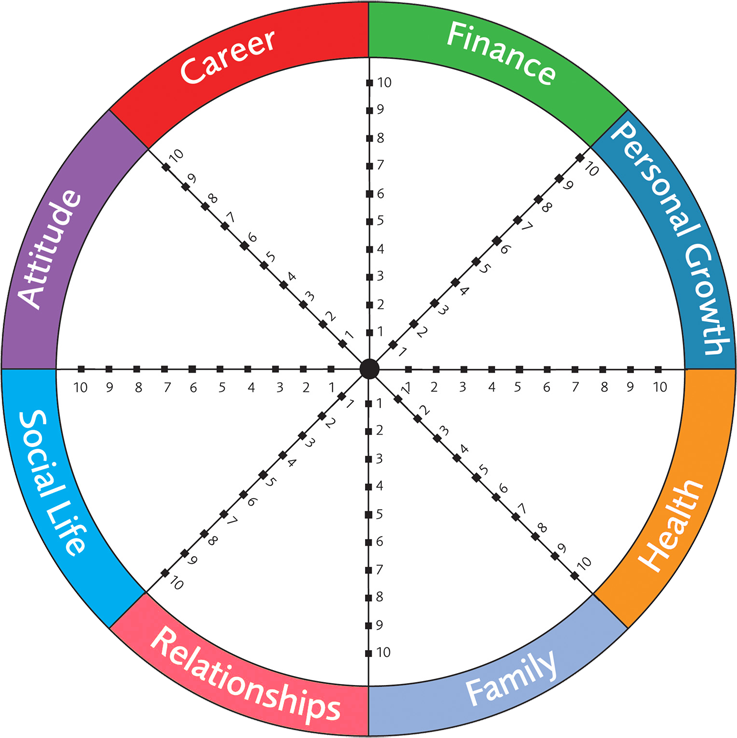
I’ve had two flat tires recently, both on bicycles. The first happened at my son’s house, forcing me to push the bike nearly two miles home. The second occurred near my own home, but since I was six miles away, I called my wife, who kindly rescued me and the bike by car. These back-to-back flats, along with a reflective fishing conversation with my son, prompted me to remember a tool I first encountered early in my corporate career—the Wheel of Life. During a week-long training session, a consultant introduced it as a practical way to reflect on and evaluate one’s life balance.
Outside of this training some forty years ago, I’ve not thought about the Wheel of Life. I know it was widely applied in coaching, counseling, leadership development, and personal goal setting, where it served as a versatile framework for fostering awareness and encouraging intentional growth. (so their purveyors claim!)
As I look around the world today at my kids and their peers, I think this perspective could use a renaissance. Originally developed in the 1960s with the work of Paul J. Meyer, a pioneer in the self-improvement industry, the concept visually represented as a circle divided into segments, each representing a key area of life such as career, family, health, spirituality, finances, personal growth, and recreation. By rating satisfaction in each area, individuals gain a snapshot of balance—or imbalance—in their overall well-being at that point in time.
The Wheel had the advantage of simplicity, adaptability, and ability to promote reflection. It encouraged people to move beyond narrow goals and consider life holistically. In years past, many used it to help others identify priorities and track progress/movement over time. Its visual nature made abstract issues more tangible offering a quick diagnostic of where energy and attention might be lacking.
This, like many other pop-culture tools has it limitations. It relies on personal perceptions that may shift with mood or circumstance. It also risks oversimplifying complex aspects of life into rigid categories, which may not fully capture cultural or individual differences.
Still, seeing it as something worthwhile to share, I roughed together my own version using a “spiderweb” chart in a spreadsheet (which you can open here for free in Google Sheets) and shared it with my kids and a few of their fellow 20-30 somethings. My hope was they would raise their head from the daily feed of social media stimuli and think about where they are investing their energy.
While tools like the Wheel of Life can offer temporary insight, my ultimate objective is to encourage the next generation to seek God’s will for their lives through a life-long study of Scripture. Unlike this Wheel tool, the Bible provides timeless wisdom, guidance, and purpose that no self-help framework can match, grounding life not in seeking balance but in seeking God’s truth and direction.
I acknowledge that discovering God’s will through the Bible can be challenging. Its ancient context, depth, and breadth may feel overwhelming to the new comer, and differing interpretations can leave readers uncertain. Yet, these challenges are not insurmountable. Practical tools can help include: reading a reliable study Bible, seeking guidance from trusted elders, pastors or mentors, and participating in small groups for shared insight. Regular prayer invites the Holy Spirit to illuminate God’s Word, while listening to Bible centered podcasts can connect Scripture to daily life. Using structured reading plans ensures consistency and exposure to the whole counsel of God. Together, these practices make discerning God’s will both approachable and life-shaping.
Unlike the fragile spokes of self-help wheels that can leave you flat, the wisdom of the Bible is a sure foundation—keeping your life balanced, your path steady, and your ride safe no matter the terrain.
UPDATE! – Try your hand at rating your Discipleship Wheel of Life. Another tab has been added (which you can open here for free in Google Sheets) to help you ascertain the “health” of your journey to grow living to the living God.