Did you spot a co-worker or cashier this week with what looked like a smudge of dirt on their forehead? If you didn’t grow up in a Christian home, you might not recognize the symbolism. A friend of mine once saw a woman at work coming out of the copier room with a smudge on her forehead. She helpfully pointed out, “Oh! You’ve got some toner on your face.” The woman, missing the chance for a teachable moment, simply shrugged and said, “Oh, it’s just Ash Wednesday.” A perfect setup for sharing her faith—missed!
She might have shared that the intended symbolism was to show her remembrance that “from dust you are and to dust you shall return” (Gen 3:19). The ashes received on Ash Wednesday symbolize mortality, repentance, and humility. Made from the burned palms of the previous year’s Palm Sunday, they remind believers that life is fleeting (palms were offered to Jesus as he entered Jerusalem only to have the excitement of His entry turn into a lynching and torture soon afterward). Probably too heavy a topic to discuss around the water cooler.
So what is Lent? First, allow me to dispel some myths. Lent was not invented by the Roman Catholics to allow parishioners a second chance to restart their failed New Year’s resolutions. Also, there is no truth to the story of a man who each week ordered three pints of beer and drank them all himself. The bartender asked why three to which the man answered he had always shared a beer with his two best friends who were now in hospice and unable to join him. The following week, the man ordered just two pints. The bartender expressed condolences and asked if one of his friends had passed away. “No,” the man said. “I’ve given up beer for Lent.” Again this is not true. It is just a story.
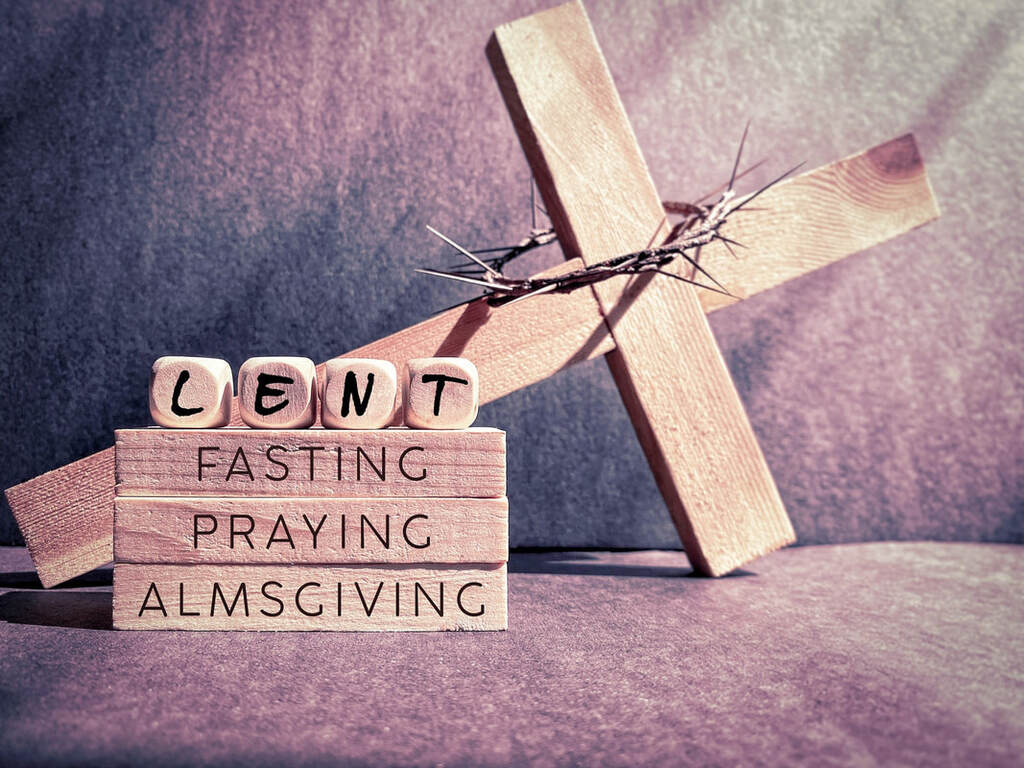
Lent is a 40-day period before Easter marked by fasting, prayer, and alms giving. It is observed by many Christians and traces its origins back to the early Church, formalized by the Council of Nicaea (325 AD). The 40 days duration echos Jesus’ fasting in the wilderness (Matthew 4:1–11) just before the start of his earthly ministry. While Roman Catholics, Orthodox, and some Protestants still observe Lent, its customs vary.
Fasting or simply giving up something (a fun activity, a favorite food, an indulgence of some kind) is intended to awaken us from the sleepy, repetitive path many of us plod along. When we inevitably experience the desire for something we’ve given up, the pang of self-denial jolts us to instead turn to prayer, reading Scripture, or performing an act of charity. Rather than focusing on the discomfort, we are to use the moment to draw closer to God, recalling Jesus’ suffering, and remembering we are relying solely on His sacrifice to allow us to one day return into the very presence of the Creator.
My childhood Lents were marked with a Friday fish fry at the fire station, tomato and mayo sandwiches (which were like a badge of meatless honor), and giving up soda which made time itself slow to a crawl. But all was forgotten with the thrill of hunting down a hastily hidden Easter basket, digging through the tangle of green plastic grass, and triumphantly unearthing sticky jelly beans and the prized chocolate peanut butter egg at the center. The sweetness of each nibble was made even richer by weeks of self-denial—every bite a victory, every treat a celebration of the wait.
As an adult, I quickly realized no one was policing my Lent observances (though my sisters tried) — and more importantly I realized I was not able to earn an extra blessing by self-imposed restrictions. I was not buying my way into God’s good graces by giving up chocolate. I was not atoning for my sin by switching to Royal Crown cola over Pepsi (it counts! look it up!) Instead, I have learned to embrace Lent as an invitation, not an obligation, using it to deepen my faith through extra Bible readings, listening to my mentor RC Sproul, and pausing to make my prayers more focused and more intentional.
My approach to Lent has changed since childhood, but now the joy of Easter can start forty days earlier. May your season of preparation not just lead to a day of Easter, but enrich your relationship with our Lord the whole year round!
Loved your writings as usual
I will try to give up sweets and fast from meat on Friday
Is there any age limit for fasting????
Some church groups require fasting as an obligation, some encourage acts of kindness, others a combination. So long as you don’t forget why you are fasting or giving something up AND ideally use the opportunity to share your faith by strengthening others in word and deed, you’ll be doing the work of the Kingdom. For Roman Catholics, this site gives info about their practices.
Thanks for yet, another lesson …. one question pops to mind. If the ashes are from ‘last years psalms’, how would lent be in Genesis ?
I always wondered growing up in Sunday school, “why did Jesus Not Pick up that Cross and carry it to the hill, as if it were a toothpick”….I know the reason, but I still wonder….Am I too being the Devil and tempting?
Lent is not referenced in Genesis or really anywhere in the Bible. Perhaps you’re referring to the reference to the use of ashes in Genesis 18:27? The OT sections of Job 2:8 and Job 42:6 also include references to sitting in ashes. The practice of Lent and putting ashes on ones head to did not start until the early AD centuries.
As to your second comment, as fully man, Jesus did many “contra naturam” (against nature) signs, but no superhuman feats (though sweating blood while praying is certainly up there).
Thank you! Tomato sandwiches and fried fish:).
One year I gave up little white donuts! This year I chose to give rather give up.?I chose Grace.. which, on some days, was difficult!
It was a blessed Resurrection Focus!