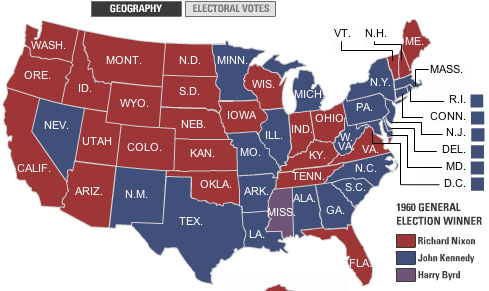
In 1858, Abraham Lincoln lifted and used a verse from the Bible in a memorable speech, not given as President, but as a candidate for the US Senate (*spoiler* he did not win). In the run up to the presidential election, the airwaves are filled with pundits quoting poles that not only show which candidate is narrowly leading in which states but conclude these results show just how hopelessly divided is our nation based on this apparent litmus test of national harmony. While my initial reaction to watching these talking heads is hopelessness and fear (which the purveyors hope drives me to continue watching their show and subsequently buying their advertised catheters and reverse mortgages), a vague memory of a presidential race from before I was born got me wondering; is this election really going to be one of the closer elections in our history?
I remember seeing a photo of President Truman holding up a newspaper with the headline “Dewey Defeats Truman” so I knew there had been close races in the past, that one in particular famously called too early. I say dim memory since this event happened in 1948, well before my personal experience. But I also recall the 2000 presidential race between Bush and Gore and the kerfuffle over the hanging chads in Florida. So, it is not really “news” that our nation is divided on who should be President and likely a false inflammation that this division is a harbinger statistic that we are on the brink of civil war. Our nation has weathered other periods of directional disagreement and can do so again IF we commit to the principles Paul espouses in his letter to the Romans.
.jpg)
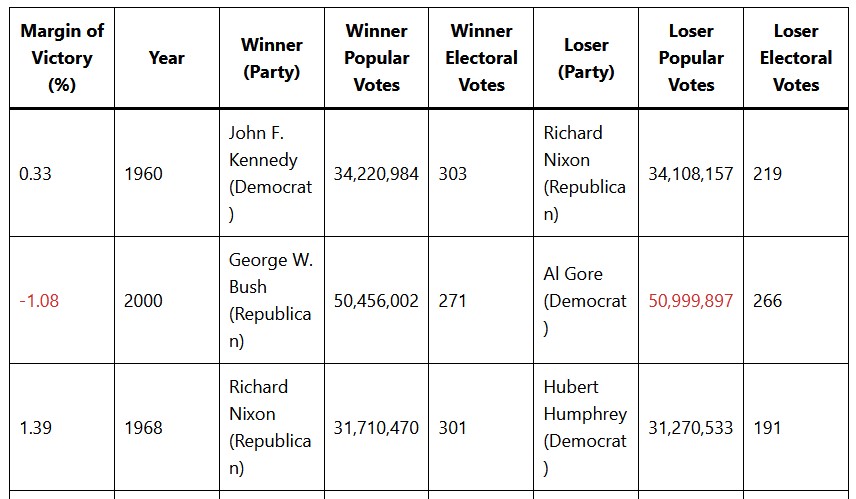
Turning to my unpaid research assistant (ChatGPT) for help, I asked him (it?) to build a table showing the results of recent, close, Presidential races. Here is what he (she?) showed me:
Table of U.S. presidential elections from 1900 to 2020, sorted by the smallest percentage difference in popular votes between the two major candidates. The table shows how close each election was (in terms of popular support) Note: two races with the larger popular vote are highlighted in red to indicate where this popular total was insufficient to meet the requirements of the Electoral College – explained here in this hilarious video by Key and Peele).
(Static view of first three rows are to aid the view of mobile users)
| Margin of Victory (%) | Year | Winner (Party) | Winner Popular Votes | Winner Electoral Votes | Loser (Party) | Loser Popular Votes | Loser Electoral Votes |
|---|---|---|---|---|---|---|---|
| 4.13 | 1976 | Jimmy Carter (Democrat) | 40,831,881 | 297 | Gerald Ford (Republican) | 39,148,634 | 240 |
| -4.55 | 2016 | Donald Trump (Republican) | 62,984,828 | 304 | Hillary Clinton (Democrat) | 65,853,514 | 227 |
| 5.97 | 2004 | George W. Bush (Republican) | 62,040,610 | 286 | John Kerry (Democrat) | 59,028,444 | 251 |
| 6.48 | 1916 | Woodrow Wilson (Democrat) | 9,129,606 | 277 | Charles Evans Hughes (Republican) | 8,538,221 | 254 |
| 8.69 | 2020 | Joe Biden (Democrat) | 81,283,501 | 306 | Donald Trump (Republican) | 74,223,975 | 232 |
| 9.04 | 1948 | Harry S. Truman (Democrat) | 24,179,347 | 303 | Thomas E. Dewey (Republican) | 21,991,291 | 189 |
| 11.12 | 1980 | Ronald Reagan (Republican) | 43,903,230 | 489 | Jimmy Carter (Democrat) | 35,480,115 | 49 |
| 14.49 | 1988 | George H. W. Bush (Republican) | 48,886,097 | 426 | Michael Dukakis (Democrat) | 41,809,074 | 111 |
| 20.74 | 1984 | Ronald Reagan (Republican) | 54,455,472 | 525 | Walter Mondale (Democrat) | 37,577,352 | 13 |
| 27.75 | 1932 | Franklin D. Roosevelt (Democrat) | 22,821,857 | 472 | Herbert Hoover (Republican) | 15,761,254 | 59 |
| 30.92 | 1964 | Lyndon B. Johnson (Democrat) | 43,129,566 | 486 | Barry Goldwater (Republican) | 27,178,188 | 52 |
| 32.64 | 1936 | Franklin D. Roosevelt (Democrat) | 27,747,636 | 523 | Alf Landon (Republican) | 16,679,583 | 8 |
So what do you see? I see seven presidential races which ended closer than the most recent one (in 2020). Five of these times our nation tabulated a difference in popular votes between the two candidates of less than 5%. The closest finish listed, Kennedy/Nixon in 1960, shows the margin of victory to be a mere one third of one percent or 112,827 votes. Now THAT is a nation nearly perfectly, evenly, divided. And we’re still here…
Seventy years have passed since that closest of presidential elections. My hope is this comparison, when held up against the seeming inconsolable divisions within our world today, brings you a measure of confidence that we’re not destined for destruction. I’m not saying the Bible is wrong to warn about disharmony, I’m saying we’re not to abandon imitating Christ out of fear the world is beyond help.
Sure you need to support your candidate’s ideas, positions, and show up and vote. But don’t let a world whose media model demands constant, hyper-agitation to change your world view from one of hope to one of impending doom and gloom. Live in confidence that whomever wins this year’s election will be just another leader in a string of earthly leaders, but Jesus will forever be the King of Kings.
Daniel, when pressed to interpret a dream of Nebuchadnezzar, praised God saying “Praise be to the name of God for ever and ever; wisdom and power are his. He changes times and seasons; he deposes kings and raises up others. He gives wisdom to the wise and knowledge to the discerning.” Daniel’s confidence in the true power of his God resulted in Daniel and his friends being appointed to lofty positions in the royal court where they influenced the earthly king.
In addition to dispatching your civic duty this fall by voting, be sure to pray that Godly men and women will be raised up and embody the traits of the King of Kings. Jesus led by example; dining with sinners, spreading a message of hope for the future, and held himself to the highest standards of conduct listed in the commandments, loving his neighbors, and loving his Creator with all his heart, soul, mind, and strength. Despite our divisions, we’ll all be stronger for it.