As a student of the scriptures, I have come across a number of answers to this question in my readings. The purpose of this essay is to capture references that explicitly refer to salvation in hopes of having a clear and complete answer to this most important question. Did the requirements change over the course of Jesus ministry? Did his apostles add to or detract from what Jesus said was required?
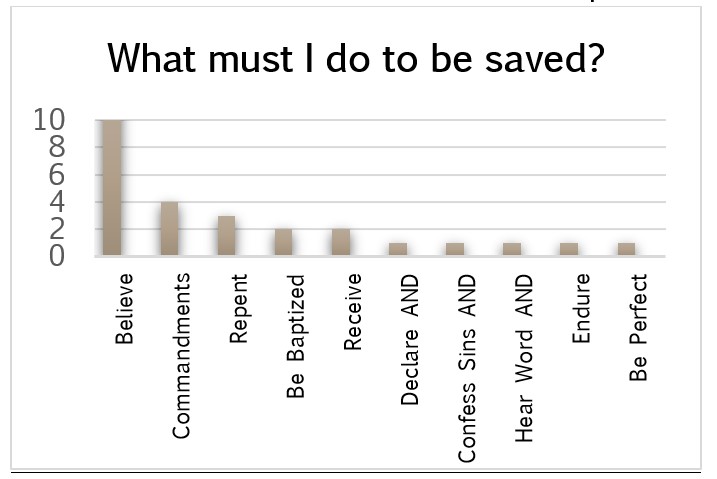
Unscientific Tally of Key Action Verbs from Scriptures
First, let’s examine what is required for salvation. The unscientific chart above shows the word “believe” to be far and away the most referenced action on the part of the salvation seeker listed in the New Testament. The second most popular action, “keeping the commandments” (and its derivation, “doing God’s will”) and the third action term, repenting when we stray from God’s will, can both be considered acting out our beliefs.
However, one should not dismiss the other articulated actions called out in other sections, with even some different ones attributed to the same author. The Old Testament corroborates the New when it lists it is “belief” on the part of Abram (Genesis 15:6) which resulted in God calling him righteous. The writer of Psalms appeals to God for help in becoming right with God, Psalm 51:10-12 says “Create in me a clean heart, O God, and renew a right spirit within me…Restore to me the joy of your salvation, and uphold me with a willing spirit.” This shows dependence on the Holy Spirit to be able to demonstrably live out our faith.
For a comprehensive understanding, one should continue to read and search the scriptures, along the way you’ll be deepening your faith through immersion in the Word of God.
You’re not the first person to ask
The Bible has a passage which specifically documents a Philippine jailer asking Paul and Silas “Sirs, what must I do to be saved?”. Paul and Silas responded, “believe in the Lord Jesus, and you will be saved, you and your household.”
If I had been the jailer, my response would have been something like “Cool! OK, ‘believe’ huh? Got it, got it. Me and my household. Cool. Cool. Ah, I’m sorry. I’m not sure what all ‘believe’ entails.”
Belief means being a FAN
Along with ‘what is belief’, I’ve often asked myself how can I know that I actually ‘do’ believe. Theologians tell us there are three essential aspects of belief, and since these are expressed in Latin, they sound really old and therefore really reliable! The three words are fiducia, assensus, notitia which listed in this order form the acronym “FAN.”
Fiducia (fə̇ˈd(y)üsh(ē)ə) refers to personal trust, confidence, and reliance. Engaging in activities which demonstrate our personal trust such as seeking life’s answers through prayer, being joyful in knowing our ultimate fate is already determined, being content in our earthly circumstances and challenges shows our faith since we “believe/have faith” in the truth of the Word of God.
Assensus is the conviction that the content of our faith is true. We can believe a chair will hold our weight, but sitting on it shows our conviction to our belief. Studying and striving to live our life patterned after the one perfectly modeled by Jesus demonstrates our conviction.
Notitia (nōˈtish(ē)ə) refers to the things we believe. From this Latin root, we get the word notion. We are called to believe certain things about Christianity that are revealed in God’s Word such as Christ is the Son of God, that He is our Savior, that He has provided an atonement for our sins.
In addition to the single word answer given by Paul to the jailer, the scriptures reveal a number passages where conjunctions and modifiers have been presented around the word “believe.” Here are some of them.
John 1:12 comments that his own people, the chosen people, did not receive him (Jesus), “But to all who did receive him, who believed in his name, he gave the right to become children of God who were born, not of blood, nor of the will of the flesh, nor of the will of man, but of God.” Seems the first step is to be exposed to and allow the truth to penetrate you; to receive it.
Matthew 7:21-23 emphasizes an activity stating “Not everyone who calls out to me, ‘Lord! Lord!’ will enter the Kingdom of Heaven. Only those who actually do the will of my Father in heaven will enter.” This passage suggests that response actions are an important element of faith, and that only those who actively follow God’s will can achieve salvation.
Paul tells his Roman readers “If you openly declare that Jesus is Lord and believe in your heart that God raised him from the dead, you will be saved. For it is by believing in your heart that you are made right with God, and it is by openly declaring your faith that you are saved. As the Scriptures tell us, ‘Anyone who trusts in him will never be disgraced.’” In a time when publicly declaring that you followed Jesus would result in ridicule and even persecution, speaking aloud was a means of validating publicly that you had both assensus (conviction) and fiducia (personal trust). Paul also provides some insight into what specifically you need to believe, that He was raised from the dead.
In the early days of the church (Acts 2:38) Peter takes a page straight from Jesus telling his listeners, “Repent and be baptized every one of you in the name of Jesus Christ for the forgiveness of your sins, and you will receive the gift of the Holy Spirit.” Peter said clearly what we have to do, but adds that we have to be ‘called.’ “For the promise is for you and for your children and for all who are far off, everyone whom the Lord our God calls to himself.” (Acts 2:39)
Acts 19:4 records Paul laying on hands and baptizing in the name of the Lord Jesus while clarifying John the Baptist’s role saying “John’s baptism was a baptism of repentance. He told the people to believe in the one coming after him, that is, in Jesus.” John goes on to elaborate on John the Baptist’s teaching in John 3:36 where he says that not believing has repercussions stating “Whoever believes in the Son has eternal life; whoever does not obey the Son shall not see life, but the wrath of God remains on him.”
John’s letter (1 John 1:9) add to the mix another activity, “If we confess our sins, he is faithful and just to forgive us our sins and to cleanse us from all unrighteousness.” So, is confession a requirement for salvation or merely a means on demonstrating our willingness to acknowledge our sins, to repent, and to instead do the will of God?
The early church taught followers what was required stating in Acts 2:41 when three thousand were added to the roster of believers “So those who received his word were baptized, and there were added that day…”
Even with forgiveness of sins as a given, we have to behave for in 1 John 5:1-5 it says “Everyone who believes that Jesus is the Christ has become a child of God. And everyone who loves the Father loves his children, too. We know we love God’s children if we love God and obey his commandments. Loving God means keeping his commandments, and his commandments are not burdensome. For every child of God defeats this evil world, and we achieve this victory through our faith. And who can win this battle against the world? Only those who believe that Jesus is the Son of God.
What did Jesus have to say?
Some modern-day disciples place greater importance of the words of Jesus than his appointed spokesmen (after all, Jesus’ words are in red in some bibles!). Here are some of Jesus’ answers to the often-asked question. I have attempted to put these into chronological order hoping to discover if there is any evolution in his speaking (though we know God is unchanging).
It seems even from the very start of Jesus’ ministry, in addition to believing, repentance plays a role as seen in passages like: In Mark 1:15 very early in his ministry shows Jesus echoing John the Baptist saying “The time is fulfilled, and the kingdom of God is at hand; repent and believe in the good news!”
In John 3:16 Jesus explains the ‘why’ we are saved saying “For God so loved the world” the ‘what”, “that he gave his only Son” and then explains the ‘how’ we are saved saying “that whoever believes in him should not perish but have eternal life.”
John 5:24 quotes Jesus saying “Truly, truly, I say to you, whoever hears my word and believes him who sent me has eternal life. He does not come into judgment, but has passed from death to life.”
In John 6:28-29 plain folks are trying to determine how they can participate saying “What must we do, to be doing the works of God?” Jesus answered them, “This is the work of God, that you believe in him whom he has sent.” And in verse 35 Jesus replied, “I am the bread of life. Whoever comes to me will me will never be thirsty.”
John 8:24 Jesus warns about not believing recalling his declaration from Exodus 3:14 saying “I told you that you would die in your sins, for unless you believe that I am he you will die in your sins.”
In John 8:31 Jesus addresses those who already telling them more was required to follow him stating “You are truly my disciples if you remain faithful to my teachings. And you will know the truth, and the truth will set you free.” Being free from sin by remaining faithful is the worthy goal for our lives.
Jesus restates the simple one-word requirement when in John 11:25 he tells Martha just before resurrecting Lazarus “I am the resurrection and the life. Whoever believes in me, though he die, yet shall he live.”
In Luke 13:3 Jesus is explaining why tragedy struck the seemingly innocent and warns “unless you repent, you will all likewise perish.”
Matthew 5:48 seemingly captures that the requirements for salvation have been put completely out of reach (without the Holy Spirit) when Jesus says “You therefore must be perfect, as your heavenly Father is perfect.”
Marks gospel, in the longer version* Jesus says “Go into all the world and proclaim the gospel to the whole creation. Whoever believes and is baptized will be saved, but whoever does not believe will be condemned.” * The longer version is not found in the earliest manuscripts. Since it is not in the original/earliest translations, some say it may have been added by someone other than Mark. Does this mean we can disregard its content? I say do so at your own risk. However, we might dare dismiss the ‘and’ requirement in “and baptized” for this reason; in the second part of the sentence, it reiterates the first requirement in the negative, it does not likewise say ‘but whoever does not believe and is not baptized’ will be condemned. It seems ‘believe’ is the operative word here, not baptism. Baptism is a sacrament of our religion, and is an external seen recognition and celebration of an unseen internal change.
Confused? A passage where it is even easier to get confused can be found in Matthew’s gospel when a rich young ruler asks Jesus, “Teacher, what good thing must I do to get eternal life?” (Matthew 19:16) Jesus responds with what seems like a return to the ‘bad old news’ of following the Commandments saying (in verse 17), “If you want to enter life, keep the commandments.” When the man asked Jesus to specify which commandments he should keep, Jesus recites “You shall not murder, you shall not commit adultery, you shall not steal, you shall not give false testimony, honor your father and mother, and ‘love your neighbor as yourself’.” This is a much longer list than “believe,” and is done as part of a lesson Jesus is teaching to the young ruler. He closes the instructional session with the student saying in verse 21 “If you want to be perfect, go, sell your possessions, and give to the poor, and you will have treasure in heaven. Then come, follow me.” Seems the message of this encounter was it is impossible for us to be perfect by following even a partial list of the commandments, but we should instead follow Jesus.
And we read following Jesus won’t be easy. Matthew 24:13 captures Jesus discussing the future, the events near the end of time, when there will be false leaders who try to lead believers astray. Jesus says “But the one who endures to the end will be saved. And this gospel of the kingdom will be proclaimed throughout the whole world as a testimony to all nations, and then the end will come.”
We’re all in agreement then, right?
It’s important to note that different Christian denominations and Christians themselves may interpret these verses and others on this subject differently. While there is no single “checklist” that guarantees salvation, I hope this collection affirms in your mind that:
• Salvation is a gift from God, extended to those whom he sovereignly chooses
• Our response to this gracious offer is to “receive and believe”
• We live out our belief by being a “FAN,” actively asking for help from the Holy Spirit to stop doing what God does not want for us (sinning) and do what God expressed is his will for us (commandments).
Knowing we all look for the Cliff’s notes, shorthand, bottom line answers to complex questions, I’ll quote Jesus (usually a safe thing to do) where in Matthew 22:35-40 he addresses an expert in religious law who tried to trap Jesus with this question; “Teacher, which is the most important commandment in the law of Moses?” Jesus replied, “‘You must love the Lord your God with all your heart, all your soul, and all your mind.’ This is the first and greatest commandment. A second is equally important: ‘Love your neighbor as yourself.’ The entire law and all the demands of the prophets are based on these two commandments.”
So that was the summary of the law from the Old Testament. What about after the cross? In John 8:31, Jesus says, “If you abide in my word, you are truly my disciples.” This statement summarizes one of the key teachings of Jesus throughout the Gospel of John, which is the importance of having a deep and ongoing relationship with him through faith and obedience to his teachings. This means staying connected to Jesus through prayer, study of his teachings, and a willingness to be transformed by his message of love, grace, and forgiveness. Are you willing? Well, not on our own, but with the help of the Holy Spirit, we can and will (eventually) “be perfect.”
Mr. Napoleon’s essays have become the jump start of my day. I have gained a better insight into my bible studies through his insightful knowledge, humor and humility.